---
title: "20 Newsgroups"
subtitle: "18,846 posts, MiniLM-384d sentence embeddings, k=20 hierarchical topics."
order: 4
image: twenty-newsgroups_files/figure-html/fig-dyf-output-1.png
categories: [text, medium, embeddings, hierarchical]
true-k: 20
format:
html:
code-fold: show
code-tools: true
execute:
warning: false
message: false
---
If Digits was k-means's home court — ten roughly-convex blobs, exactly the geometry k-means was born to carve — 20 Newsgroups is an away game. Sentence embeddings produce *curved* topic manifolds that share vocabulary at their borders: `comp.sys.ibm.pc.hardware` and `comp.sys.mac.hardware` bleed into each other; `talk.politics.mideast` and `talk.religion.misc` share a substantial amount of language. K-means has to slice straight Voronoi lines through those seams. DYF can follow the curve.
That's the prediction. Let's see whether it pans out.
## Load 20 Newsgroups
```{python}
#| label: load
from sklearn.datasets import fetch_20newsgroups

data = fetch_20newsgroups(
    subset="all",
    remove=("headers", "footers", "quotes"),  # strip boilerplate so the model scores on content
)
print(f"{len(data.data):,} posts across {len(data.target_names)} classes")
print(f"Examples: {data.target_names[:4]} ...")
```
## Embed with MiniLM-L6-v2 (384d)
Sentence embeddings, not TF-IDF. This is the standard "turn text into semantic vectors" move and it's what downstream RAG / retrieval systems actually use. Cached to `/tmp` on first run so re-renders are cheap.
```{python}
#| label: embed
import os
import numpy as np
import time

CACHE = "/tmp/twenty_ng_minilm.npz"

if os.path.exists(CACHE):
    z = np.load(CACHE)
    X, y = z["X"], z["y"]
    print(f"Cache hit: {X.shape[0]:,} × {X.shape[1]}d embeddings")
else:
    from sentence_transformers import SentenceTransformer
    model = SentenceTransformer("sentence-transformers/all-MiniLM-L6-v2")
    t0 = time.time()
    X = model.encode(data.data, show_progress_bar=False, batch_size=64)
    X = np.ascontiguousarray(X, dtype=np.float32)
    y = np.asarray(data.target)
    print(f"Embedded {X.shape[0]:,} posts in {time.time() - t0:.1f}s → {X.shape[1]}d")
    np.savez(CACHE, X=X, y=y)
```
## Run DYF (parameter-free)
Same call as every other notebook in this gallery — no arguments tuned for text.
```{python}
#| label: run-dyf
import sys
sys.path.insert(0, ".")
from _gallery import run_dyf, run_kmeans, plot_single, metrics_table

result = run_dyf(X, y)

print(f"Recovered k: {result.recovered_k}  (true k = {result.true_k})")
print(f"AMI:         {result.ami:.3f}")
print(f"ARI:         {result.ari:.3f}")
```
## Oracle k-means baseline
```{python}
#| label: kmeans
kmeans = run_kmeans(X, y)
print(f"k-means AMI={kmeans['ami']:.3f}, ARI={kmeans['ari']:.3f} (told k={result.true_k})")
```
## What about HDBSCAN?
Skipped here. On 18,846 × 384d, HDBSCAN's defaults take ~2.5 minutes of wall clock and then flag **84% of points as noise** — it's scoring AMI on only the 16% of posts it was willing to cluster. The comparison becomes unfair in the other direction (HDBSCAN is allowed to pick its battles), and the notebook render balloons by 2+ minutes for a mostly uninformative number. The digits notebook keeps HDBSCAN because the noise fraction is small there; here it's not a useful reference.
## Figures
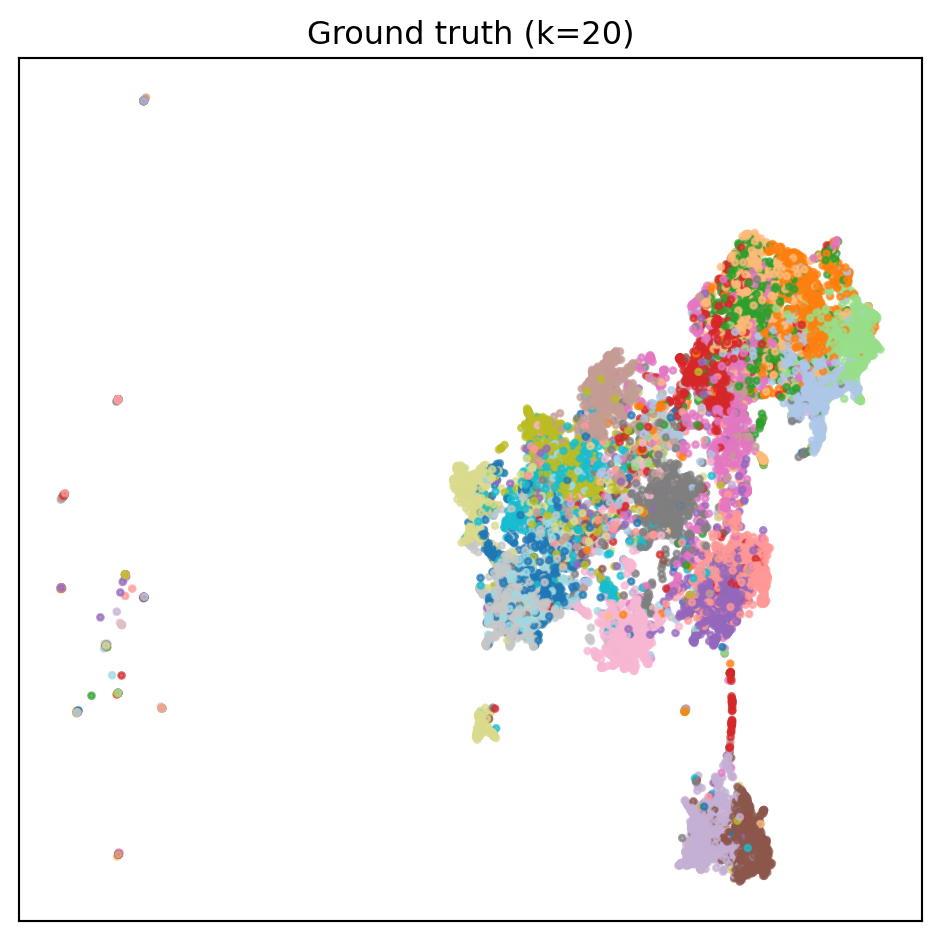
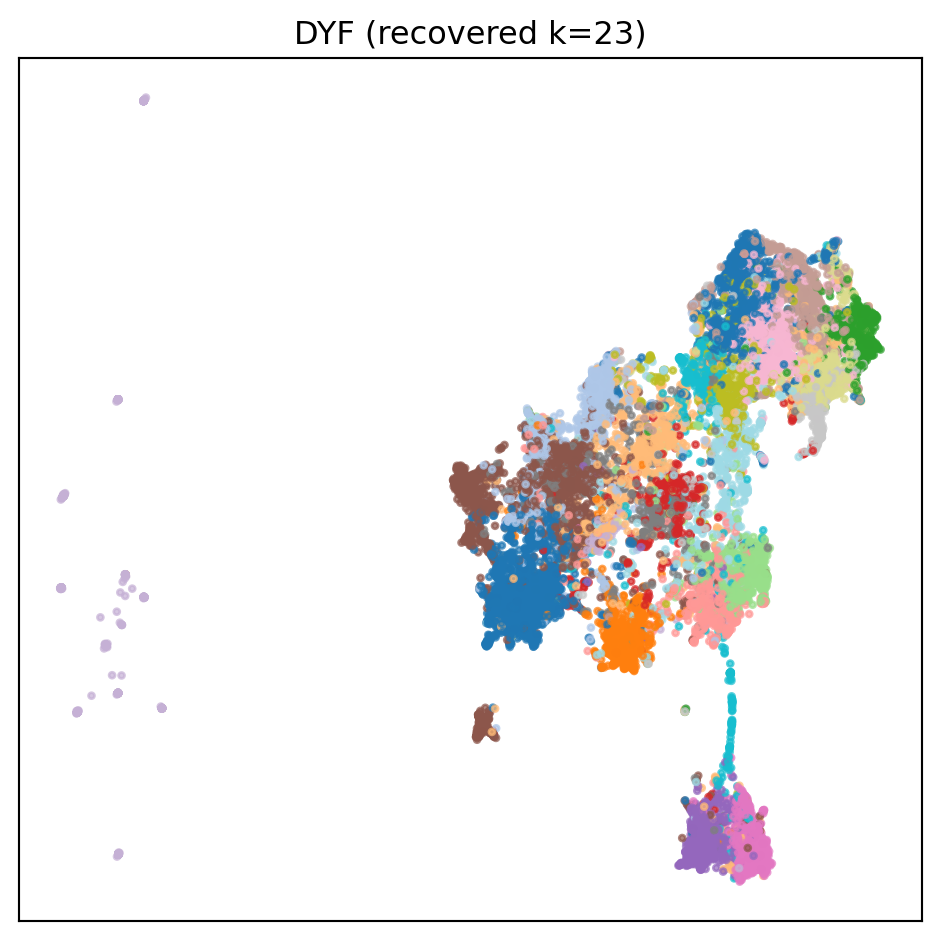
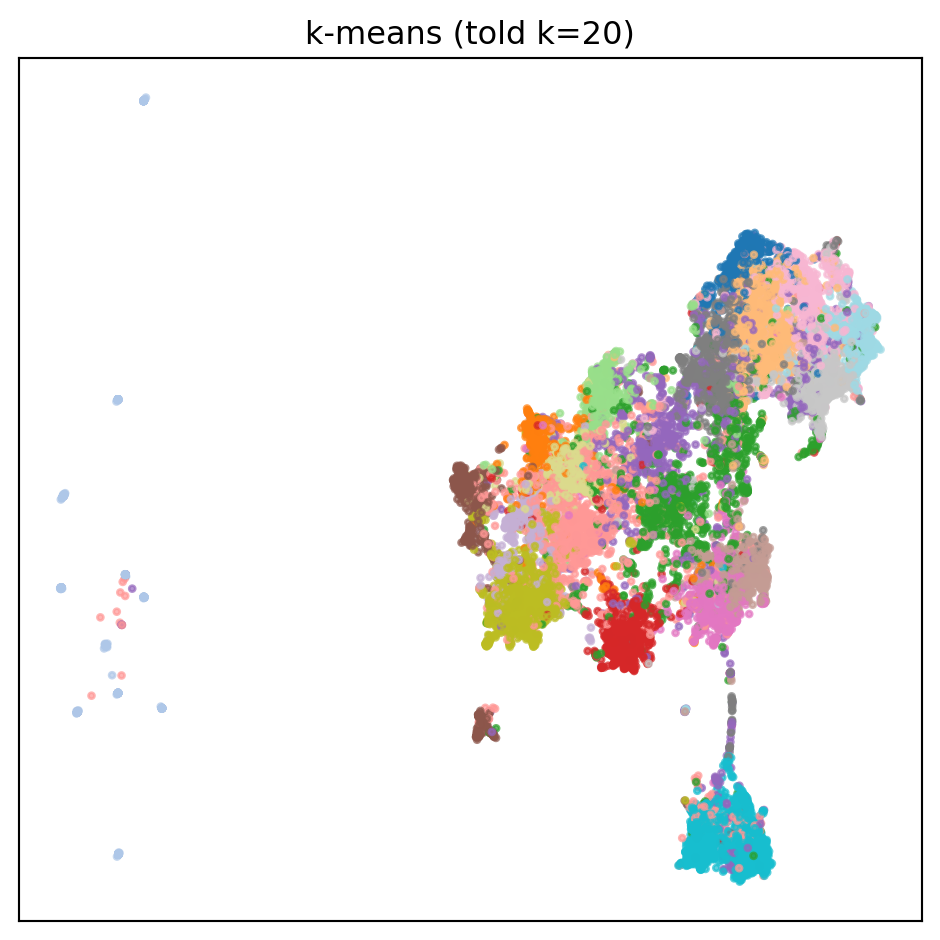
Three views of the same UMAP layout: ground-truth classes, DYF's parameter-free partition, and k-means given the oracle `k=20`.
::: {.gallery-fluid}
```{python}
#| label: fig-truth
#| fig-cap: "Ground truth — 20 newsgroup classes."
plot_single(result.umap_2d, y, title=f"Ground truth (k={result.true_k})")
```
```{python}
#| label: fig-dyf
#| fig-cap: "DYF — parameter-free, no k supplied."
plot_single(result.umap_2d, result.labels, title=f"DYF (recovered k={result.recovered_k})")
```
```{python}
#| label: fig-kmeans
#| fig-cap: "K-means given the oracle k=20."
plot_single(result.umap_2d, kmeans["labels"], title=f"k-means (told k={result.true_k})")
```
:::
## Metrics
```{python}
#| label: metrics
#| output: asis
print(metrics_table(result, kmeans, None))
```
## Twelve communities for twenty classes — which twenty?
DYF stopped at 12. That is well short of the flat label's count, and it could mean two very different things: the community-detection stage under-resolved the leaf graph (as it does on [Digits](digits.qmd), a much smaller dataset), or DYF landed on a *coarser real level* of the newsgroup hierarchy. 20 Newsgroups has seven top-level buckets — `alt`, `comp`, `misc`, `rec`, `sci`, `soc`, `talk` — so the second reading is testable: score the same partition against the top-level label.
```{python}
#| label: top-level
from sklearn.metrics import adjusted_rand_score, normalized_mutual_info_score

top_names = sorted({n.split(".")[0] for n in data.target_names})
y_top = np.asarray([top_names.index(data.target_names[t].split(".")[0]) for t in y])

def score(lab):
    return normalized_mutual_info_score(y_top, lab), adjusted_rand_score(y_top, lab)

print(f"{len(top_names)} top-level groups: {top_names}\n")
print(f"{'partition':32s}   AMI    ARI   (vs top-level label)")
for name, lab in [(f"DYF raw (k={result.recovered_k})", result.labels),
                  ("k-means (told k=20)", kmeans["labels"])]:
    n_, a_ = score(lab)
    print(f"{name:32s}  {n_:.3f}  {a_:.3f}")
```
Compare the two rows to the same methods scored against the 20-class label above. The answer is *both readings at once*. DYF's twelve communities keep the top-level structure better than k-means's twenty do — ARI 0.313 vs 0.214 against the seven buckets, AMI 0.450 vs 0.426 — and DYF's ARI is close whether you judge it by buckets (0.313) or by the 20 classes (0.341), which is what a partition sitting between two levels of a hierarchy looks like. But AMI 0.45 against seven buckets is not a clean seven-way split either. The twelve communities are coarser than the leaves and finer than the branches, and they respect the branches about as well as anything here does.
## Walking down the hierarchy
Whatever the reading, DYF's 12 communities are the top of a partition hierarchy that can be collapsed further:
```{python}
#| label: merge-walk
#| output: asis
from _gallery import merge_walk, merge_walk_table

walk = merge_walk(result, X, y, targets=[25, 20, 10, 7, 4])
print(merge_walk_table(walk, result))
```
Targets above 12 are no-ops. `merge → 7` is the interesting row: seven is the number of top-level newsgroup buckets. Collapsing to it costs 0.08 AMI and 0.13 ARI against the 20-class label — a real loss, but a smaller one than k-means's twenty clusters suffer when judged at the bucket level (ARI 0.345 → 0.214 in the cell above). The coarse structure is in the tree; it is just not the level DYF stopped at.
## How DYF and k-means disagree — and why
Compare this to the Digits notebook:
| Dataset | k-means AMI | DYF AMI | Gap |
|----------|------------:|--------:|------:|
| Digits | 0.773 | 0.668 | 0.105 |
| **20 Newsgroups** | **0.505** | **0.499** | **0.006** |
**The gap all but closed.** On text, oracle-tuned k-means is under a hundredth of AMI ahead of DYF-with-no-knobs, at 12 clusters to its 20. Two things changed between the notebooks:
**1. The manifold started to bend.**
Sentence embeddings for `comp.sys.ibm.pc.hardware` and `comp.sys.mac.hardware` overlap — they share vocabulary ("driver", "boot", "RAM"), writing style, question types. In UMAP those classes don't sit as disjoint blobs; they bleed into each other along a curved seam. K-means has to plant a Voronoi boundary *somewhere* in that seam, and wherever it plants it, it misclassifies the items near the line. DYF's density-based cut can follow the seam instead of cutting straight across it.
**2. The tree is bigger.**
Digits hands community detection ~190 leaf centroids and gets under-split to 8 for 10. Here the tree has several times as many leaves and DYF recovers 12 for 20 — still coarse, but the label it is coarse *against* is itself a two-level hierarchy, which is why the top-level cell above exists. On [MNIST](mnist.qmd) (70,000 points, thousands of leaves) the same code recovers 12 for 10. Leaf count, not sample count, is the axis to watch.
### The home-court / away-game framing, continued
K-means is a superb algorithm when the problem matches its inductive bias: *"minimize within-cluster Euclidean variance, and I'll tell you how many clusters there are."* Digits satisfies both conditions perfectly — ten convex blobs, k handed over. Text embeddings break both conditions at once: the geometry isn't convex, and the real number of semantic communities isn't even well-defined (there are 7 top-level topic groups, 20 flat labels, and a debatable number of sub-topics).
On its home court k-means wins by 0.105 AMI. On the away game it wins by 0.006. The remaining notebooks — Olivetti Faces (40 identities, 10 examples each, *very* non-convex in pixel space) and CMU MoCap (continuous motion manifolds, no single right `k`) — push both methods into regimes where neither does well, for different reasons.
### Pros and cons recap
| | **DYF (parameter-free)** | **K-means (oracle k=20)** |
|----------------------------|----------------------------------------------------------------------|---------------------------------------------------------|
| Needs `k`? | No. | Yes — given 20 upfront. |
| Behavior on curved manifolds | Follows density; can trace seams. | Cuts straight Voronoi lines across them. |
| Behavior when true structure is hierarchical | Stops at one level of it (12 here); the merge walk gives the coarser ones. | Forced to a flat 20-partition; can't express hierarchy. |
| Behavior when embedding noise is high | Tree leaves absorb some noise before Louvain merges. | Sensitive — outliers pull centroids. |
| Tree output | Yes — can re-cut at coarser resolution post-hoc. | No — flat at exactly `k`. |
## What to take away
- **DYF comes within 0.01 AMI of oracle k-means on text**, without `k` and with 12 clusters to its 20.
- **The recovered 12 is coarse against the 20-class label, and half-right against the 7-bucket one.** It keeps the top-level structure better than oracle k-means's twenty clusters (ARI 0.31 vs 0.21) without being a clean seven-way split. Read the two scores together; either alone tells a tidier, wrong story.
- **Embedding dominates the clock.** Encoding 18,846 posts takes tens of seconds; either clusterer then finishes in about a second (`wall (s)` above), with DYF the slower of the two. On a real corpus the embedding step is the cost to plan around.
- **HDBSCAN doesn't scale here.** 144 seconds and 84% discarded is a dealbreaker at 18K+ documents, which is small by real-world RAG standards.
- **Parameter-free is getting cheaper to justify.** On digits the oracle gave k-means a 0.105 AMI edge; here it bought 0.006. The cost of not knowing `k` drops as the geometry gets harder — which is the regime you're in whenever you don't already know what's in your corpus.
- **Earlier versions of this page reported 23–34 communities** and read them as sub-topic hierarchy. That count came from a single-level Louvain in `dyf-rs` before 0.12.0 that could not merge communities (dyf `KNOWN_ISSUES.md`, issue 10); the numbers here are from the corrected optimiser.